
Quick Answer
Take an M4 with a 60-round magazine for mid range (or a short MCX for towns), Class III++ plates, one loaded and two spare magazines, one or two stacks of loose ammo, two grenades, a tourniquet, a bandage, a splint and a suture kit, plus chocolate and water. Wear a boonie by day and a high-cut helmet at night so you can mount night vision. Keep the total light enough to move: too much weight stops your character entirely.
What should you pack for budget tasks, close quarters, long range, night raids, and PvE or PvP?
Start from one standard kit and swap the weapon and helmet for the job.
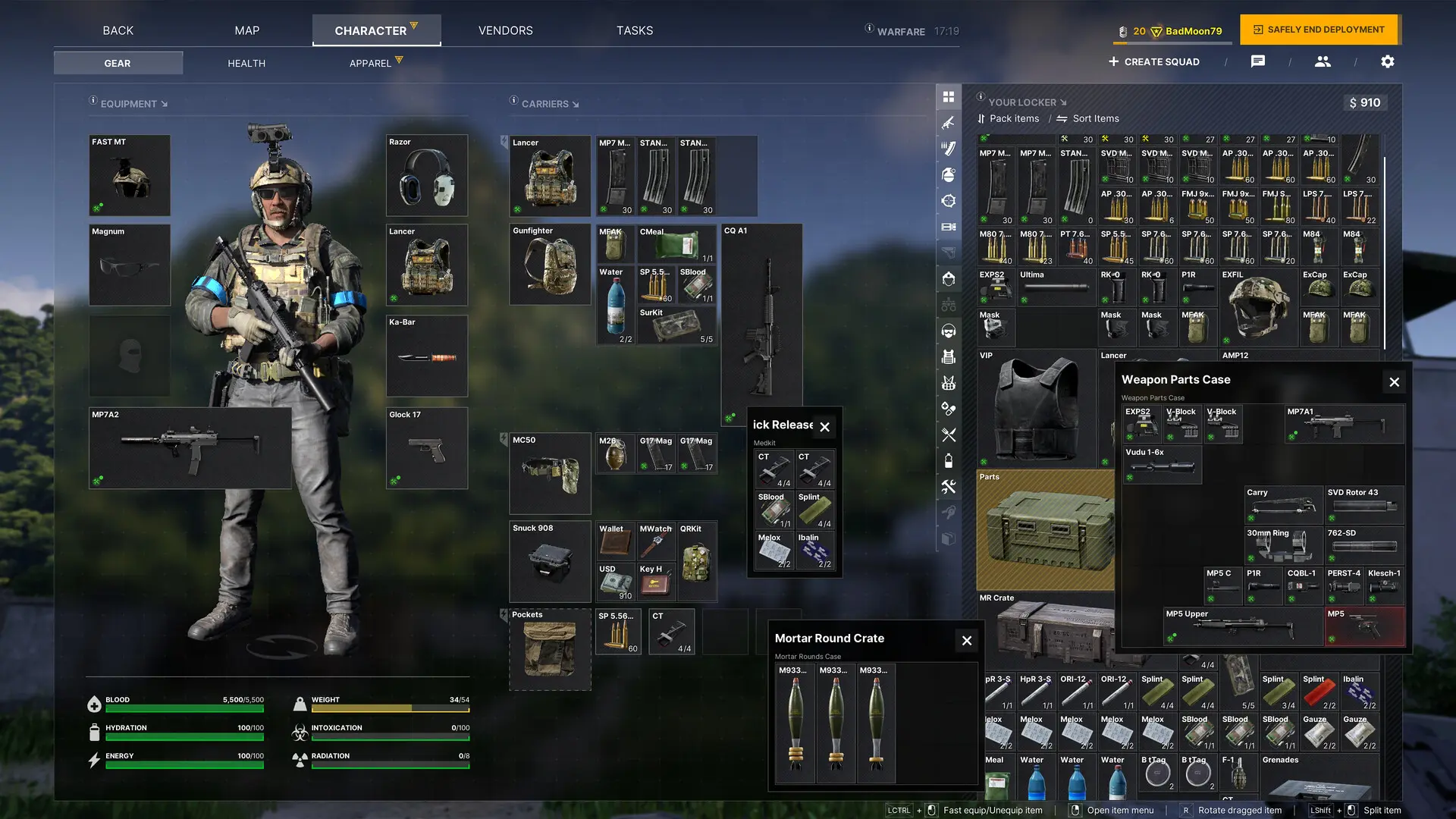
| Slot | Standard pick |
|---|---|
| Main weapon | M4 with a 60-round magazine for mid to long range |
| Close-quarters weapon | Short MCX for towns |
| Armor | Class III++ plates in a plate carrier |
| Helmet | Boonie by day, high-cut helmet at night for night vision |
| Ammo | One loaded magazine, two spares, one or two stacks of loose rounds |
| Grenades | Two |
| Medical | Tourniquet, bandage, splint, suture kit |
| Food and water | Chocolate and water outside towns; loot more inside towns |
| Backpack | Medium |
| Job | What to change |
|---|---|
| Budget task | A cheap M4 with A1 ammo; leave expensive attachments at base |
| Close quarters | Short MCX instead of the long rifle |
| Long range | Long-barrel suppressed M14 EBR with a rangefinder; see Gray Zone Warfare sniping |
| Night raid | High-cut helmet with night vision mounted |
| PvP | Your best armor and helmet; you will be shot at by players, not just AI |
Most new 0.5 weapons, like the Benelli M4, FAMAS, G3, G36, Glock 18C, Steyr AUG and UMP, are found in the world rather than bought, so build around what you already own.
What weapon build, attachments, ammunition, and spare magazines should you bring?
Bring spare magazines and loose ammunition with your weapon, and keep ammunition wound effects separate from attachment choices.
Spare magazines and loose rounds serve different packing needs. Make room for both instead of treating a large ammunition stack as the entire ammunition portion of your loadout.
In 0.5, soft-point (SP) and hollow-point (HP) ammunition create larger wounds than full metal jacket (FMJ) and armor-piercing (AP) rounds. That comparison describes wound size. It does not provide a penetration ranking or establish one round as the best choice against every target.
The weapon pool also includes Benelli M4, FAMAS, G3, G36, Glock 18C, Steyr AUG, and UMP. Most new weapons are found throughout the world rather than purchased from vendors, so do not plan a shopping trip around buying every new option.
Weapon and weapon-part durability increased by 40% in 0.5. Keep that change separate from claims about accuracy, recoil, or attachment compatibility.
Once you have chosen your rifle and optic, check Gray Zone Warfare weapon zeroing as part of preparing for aimed shots.
How should you balance armor, plate coverage, helmets, and weight?
Consider the armor, plates, helmet, ammunition, medical supplies, and pack as one carried load before adding more equipment.
The hard consequence of excessive weight is loss of movement. A protection choice therefore also belongs in your carrying-capacity decision. Leave room in that decision for the supplies you intend to carry alongside the armor.
Too much weight stops your character from moving at all. Stamina drops off noticeably once you carry around 35 kg, so treat that as the point to start cutting extras.
Keep replacement cost in view when choosing the protection you take. For the consequences of losing equipment, read what happens when you die in Gray Zone Warfare before committing your budget.
What medical supplies and treatment coverage should you pack?
Pack for wounds, bleeding, bone injuries, organ damage, and blood loss, and count treatment needs by affected body part rather than by individual injury.
A single splint application can treat both fractured bones in the same leg. If both legs are broken, you need two applications, one for each leg. This is a treatment calculation, not a fixed recommendation to bring exactly two splints on every trip.
Bandages can treat multiple injured body parts in one use. Check the item's body parts healed per use stat when comparing treatment coverage. Counting bandages alone misses that difference.
Higher-quality medical items work faster, and military-grade supplies are more effective than civilian alternatives. The following use times give you concrete differences to consider:
| Item | Use Time |
|---|---|
 | 4 seconds |
 | 4.5 seconds |
 | 16 seconds |
 | 18 seconds |
Surgical kits can treat broken bones, organ damage, and bleeding. Blood bags replenish blood, and their contents are consumed by the volume needed rather than by a fixed charge.
Hemostats and tourniquets stop bleeding from every body part, but a tourniquet cannot be applied to the head or torso. Carry a hemostat as well if you want a fix for torso bleeding.
Stopping bleeding does not remove pain if the injured limb remains untreated. Severe arm injuries trigger tremors, arm injuries affect maximum arm stamina, and leg injuries affect maximum body stamina. Treating the underlying injury matters beyond stopping blood loss.
Hover over injured body parts to see their approximate remaining durability. The health panel also displays a notification and warning icon when a medical item cannot be used. Stims must be crafted rather than purchased from vendors, so include that preparation before departure if you intend to carry them.
What utility gear, night vision, food, water, and carrying capacity do you need?
Plan utility equipment and provisions around deployment length, then check their weight alongside your ammunition and medical supplies.
Keep night vision on the packing checklist for a night deployment. Treat its setup as part of preparing the kit rather than an item to remember after you leave. For food and water, decide what you intend to carry before filling the pack with optional equipment.
Drinks are consumed by volume: your character uses only the amount needed. Check remaining contents when preparing provisions instead of treating every partly used bottle as an empty one.
The same principle applies to blood bags. Remaining volume matters when reviewing medical supplies for another deployment. A longer trip makes that review more useful because provisions, ammunition, and medical supplies all compete for carrying space.
Before departure, review the complete load together. Adding supplies to solve one problem can create another if the total becomes excessively heavy.
With the kit packed, move on to Gray Zone Warfare advanced combat tips to prepare for the fighting ahead.
FAQ
An M4 with a 60-round magazine, Class III++ plates, one loaded and two spare magazines, loose rounds, two grenades, basic medical items, chocolate and water.
Treating both broken legs takes two splint applications. Multiple fractures within one leg can be treated with one application.
The M.F.A.T. tourniquet takes 4 seconds, compared with 4.5 seconds for the retractable tourniquet.
Yes, HP and SP ammunition create larger wounds than AP and FMJ ammunition in 0.5. Wound size does not establish a penetration ranking.
No, stims must be crafted. Prepare them before departure if they are part of your intended kit.
Excessive carrying weight prevents movement. Include armor, ammunition, medical supplies, and provisions in the same weight decision.